


Society
Krupko: Operation Bagration was a masterpiece of military art, an example of exceptional courage
24.06.2026
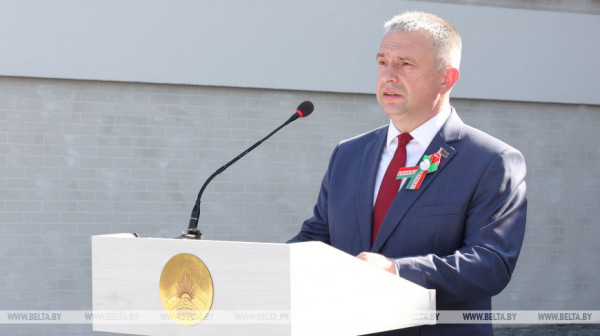
Operation Bagration is a masterpiece of military art and an example of exceptional courage, resilience, and unity of a nation who fought for their land. Chairman of the Gomel Oblast Executive Committee Ivan Krupko emphasized that at the solemn reopening of the military glory complex in honor of Operation Bagration, which is located in Svetlogorsk District, after its large-scale reconstruction, BelTA has learned.
“Today is a special day. Exactly 82 years ago, on 23 June 1944, Operation Bagration began – an offensive that changed the course of the Great Patriotic War, brought the Victory closer, and became a symbol of the indomitable strength of a victorious people. And it is today that we are opening the renovated memorial complex dedicated to these heroic events,” the head of the oblast administration noted.
“And this is deeply symbolic. Time seems to connect the two banks of one river: the heroic June of 1944 and our present day, in which we carefully preserve the memory of the Great Victory,” he added.
The head of the oblast administration recalled that the operation was named after Piotr Ivanovich Bagration, an outstanding commander of the French Invasion of Russia of 1812. “A man who, throughout his entire military career, never suffered a single defeat. Thus, the very name embodied the frame of mind for victory and faith in one’s own strength and in the righteousness of one’s cause. The world witnessed a masterpiece of military art and an example of exceptional courage, resilience, and unity of a nation who fought for their land, for their loved ones, and for the right to live freely,” Ivan Krupko said.
For the Belarusian people Operation Bagration has a special meaning, the chairman of the Gomel Oblast Executive Committee emphasized. “It became the road to the liberation of Belarus. In just a few weeks, our capital city was cleared of the fascists, and then, one after another, the towns and districts of the republic were liberated. From Vitebsk and Orsha to Pinsk and Brest. From Lake District to the Polesie area,” he specified.
The operation entered the country’s history as Belarus’ victorious return to life, the governor pointed out. “There is profound symbolism in the very date it began. Exactly three years after the war came to our land, the Red Army launched a decisive offensive. It is as if history itself counted the time from tragedy to liberation,” the head of the oblast administration noted.
He also stressed that the scale of the operation remains staggering even today. “It united the efforts of four fronts, partisan formations, aviation, thousands of commanders, and millions of soldiers. But its main result was measured not in kilometers of troop advancement or staff reports. The main result was the liberated Belarusian land, our cities and villages, and the hope for life returned to the people. It is for a reason that the Belarusian people chose the day Minsk was liberated – 3 July – as Independence Day of the Republic of Belarus. This decision unites historical memory, gratitude to the generation of victors, and an understanding of the price at which the freedom of our native land was won,” the head of the oblast administration stated.
Among the millions of participants of the operation were people of many different nationalities, ages, professions, and destinies. “They were all united by a love for the Motherland and a readiness to defend it to their dying breath. That is precisely why, decades later, the memory of them continues to live on. It lives in family histories, in yellowed frontline photographs, in museums, in search work, and in flowers at obelisks. And, certainly, in memorials such as this one,” Ivan Krupko concluded.
The Belarusian offensive Operation Bagration is one of the largest military operations of the Great Patriotic War of 1941-1945.
The offensive operation lasted for 68 days and was conducted in two stages: the first from 23 June through 4 July, and the second from 5 July through 29 August. The pace of the offensive was 25-30km per day.
